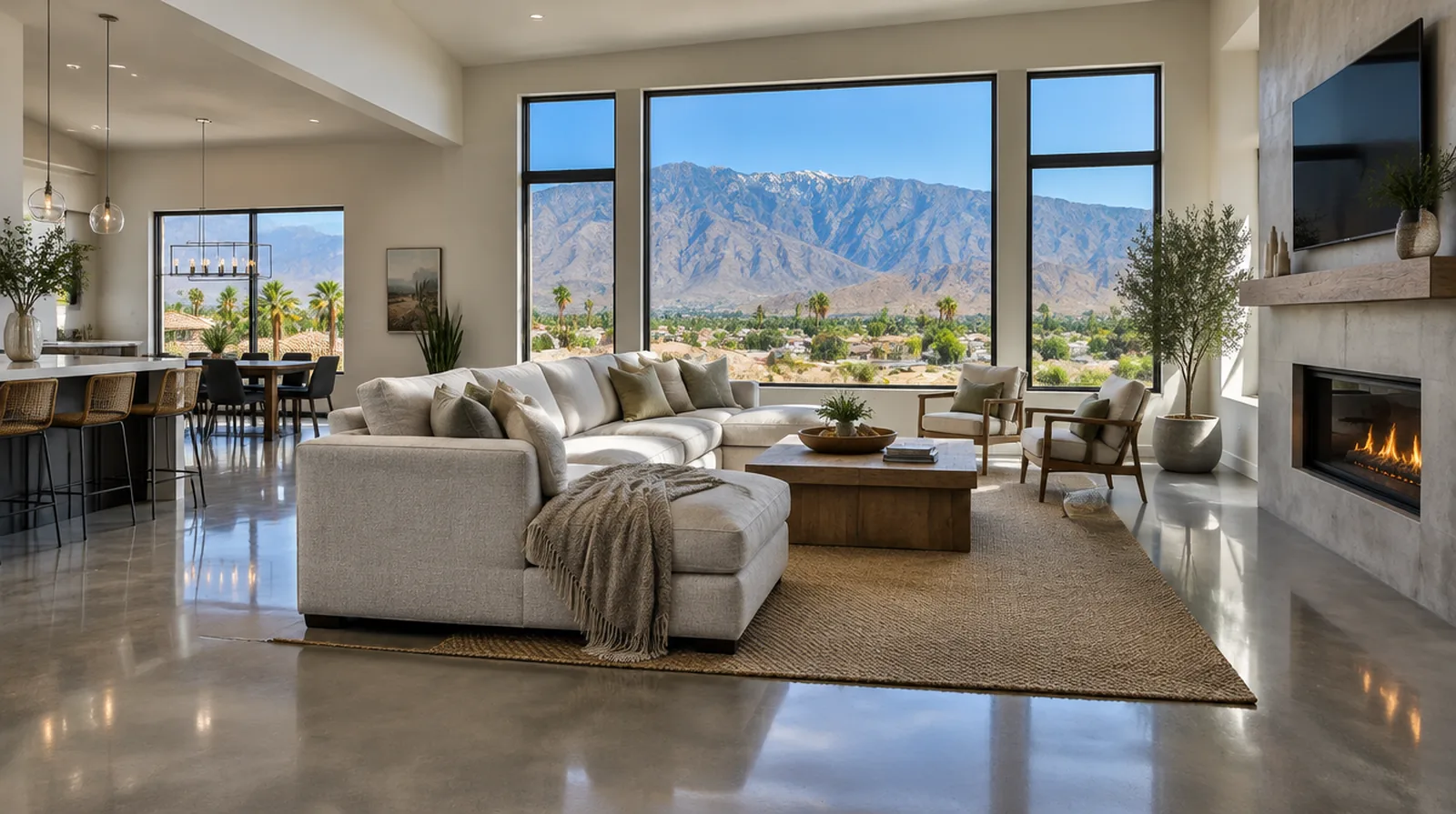
Polishing the slab itself
Polished concrete is not a coating. We grind the slab with progressively finer diamond tools, treat it with a hardening densifier and polish it until it shines. The finish is part of the concrete, so it cannot peel or flake. A penetrating guard helps resist stains.
In a hot inland valley, polished concrete has a real advantage: it stays cool. Homeowners who pull out carpet often find the bare slab more comfortable in summer, and it is easier to keep free of dust and allergens.
Choosing the look
A light grind keeps the smooth surface for a uniform look. A medium grind shows fine aggregate, often called salt and pepper. A deep grind exposes larger stones. Sheen ranges from satin to high gloss. Dyes can add warm browns, tans or charcoal that suit desert-style homes. We make test patches so you can see your actual floor first.
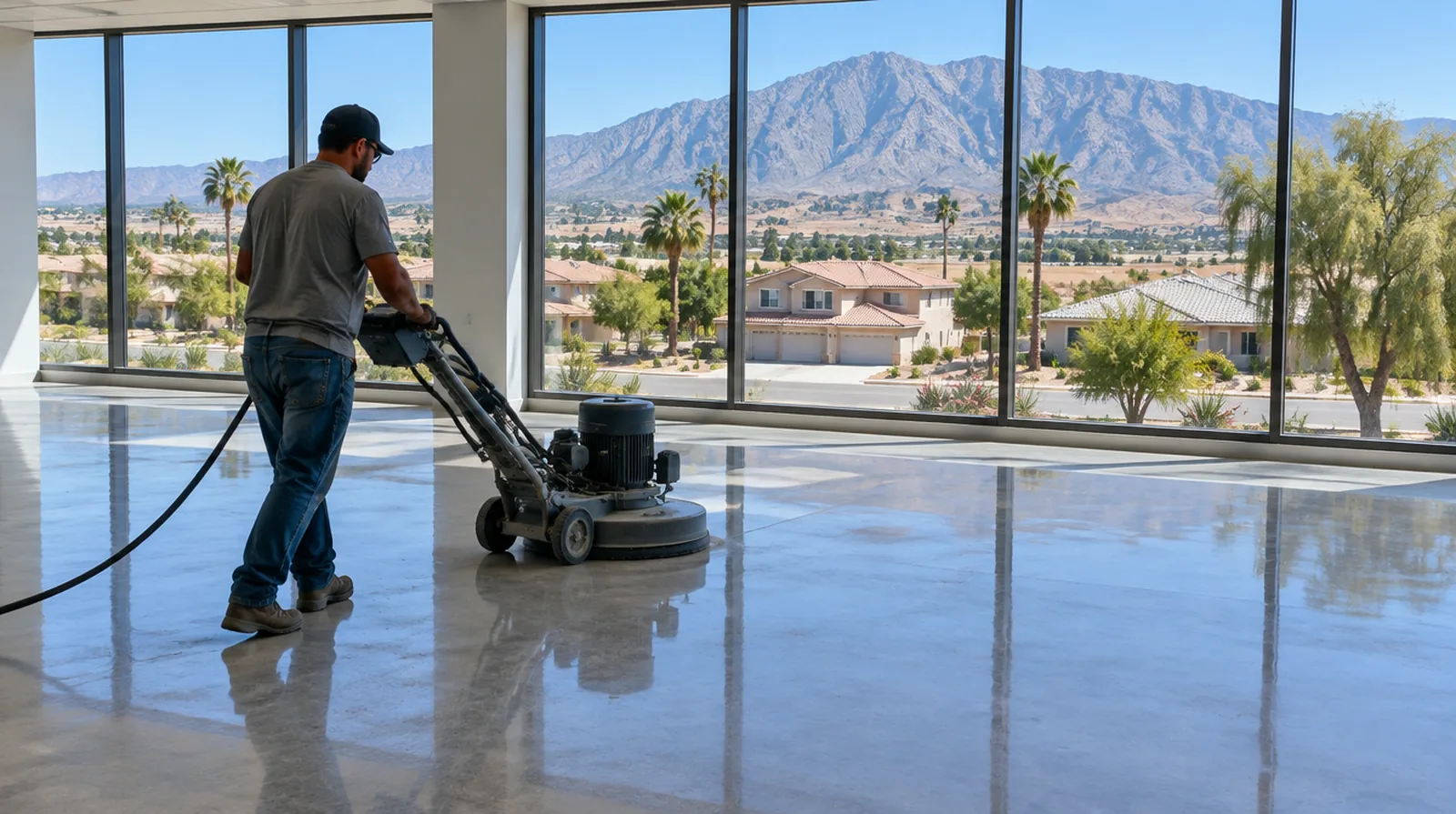
The process
We evaluate the slab, remove coverings and adhesive, then grind with dust collection. Cracks and holes are filled. A lithium densifier hardens the surface, resin diamonds build the shine and a guard and burnish finish the job.
Homes and casitas
Polished concrete works well in living rooms, kitchens, casitas and converted garages. It pairs with rugs for warmth in winter and stays cool in summer. Tack strip holes and adhesive marks from old carpet can remain as character marks or be filled.
Businesses
Retail stores, offices, showrooms and restaurants like polished concrete for its long life and low upkeep. No wax, no stripping and no coating to replace.
Is your slab a candidate?
Most interior slabs can be polished. Heavy damage and patches will show. Soft concrete may need extra densifier. Garages with heavy oil staining are usually better served by a coating.
Breathability
Polished concrete lets moisture escape, so it is a smart choice where moisture readings would be risky under a coating.
Maintenance
Dust mop frequently, since valley dust can dull the shine over time. Clean with a pH-neutral cleaner and wipe up acidic spills quickly. A re-burnish every few years restores gloss.
Questions
Is it slippery?
Dry polished concrete has good traction. Use mats at entries.
Will it look uniform?
No, natural variation is part of the look.
Can it be polished in a new home?
Yes, and planning early with your builder helps.
Curious about your slab? Book a free estimate.
Dyes and desert tones
Many homes here use warm earth tones inside and out. Acetone-based and water-based dyes can tint polished concrete in shades of tan, terracotta, walnut and charcoal that complement stucco, wood beams and stone fireplaces. Dyes can be applied uniformly or in patterns, such as borders, scored squares or a different color in a kitchen zone. We test dyes on a small section so you can approve the color before we treat the whole floor.
New construction and additions
If you are building a new home, a casita or an addition, polishing is easiest to plan before the slab is poured. A good concrete mix, careful finishing and protection during construction all make a better polished floor. We can talk with your builder about these details and schedule polishing after drywall and paint but before cabinets and trim, when the floor is most accessible.
Cost and value
Polished concrete often costs less than tile, stone or high-end vinyl, and it rarely needs replacement. There is no grout to seal, no planks to lift and no wax to strip. Over ten or twenty years, that low upkeep adds up to real savings. For businesses, it means fewer closures for floor work. For homeowners, it means a durable, cool floor that suits the valley climate and looks better as it ages.
Because the finish is part of the slab, scratches can be honed out and the shine restored on site without tearing anything up or closing the room for long.
Get a polished concrete quote
Call (951) 618-1370 for a free estimate.